
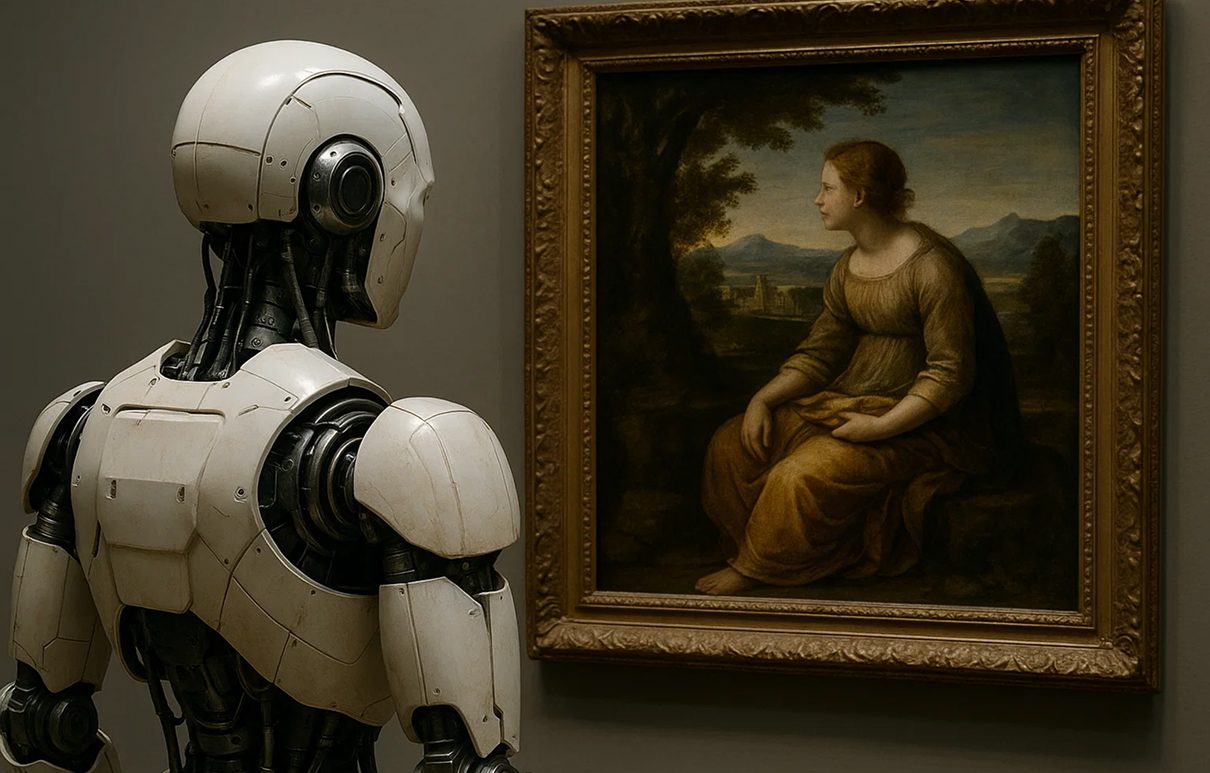
Reflections by Katerina Karp, Curator, Visual Artist, Researcher
Art is not merely a reflection of reality. It is a means through which knowledge itself is constructed and articulated in visual and semiotic forms.
Exploring Epistemology through Art and Curatorial Practice: Reflections by Katerina Karp, Curator, Visual Artist, Researcher, Journalist
As we move at an almost inconceivable speed across the ever-shifting landscape of contemporary art and technology, it becomes increasingly crucial to understand how knowledge is created, transmitted, and perceived. The intersection of epistemology—the philosophy of knowledge—and curatorial practice opens a unique space for examining the complex and often invisible processes that shape our perception of the world. For me, as an artist and curator, epistemology is not just an academic discipline. It forms a vital foundation influencing both my creative projects and my curatorial work.
Epistemology: The Philosophy of Knowledge
At its core, epistemology is concerned with the theory of knowledge—what it is, how we acquire it, and how we justify our beliefs. This field investigates the very foundations of knowledge, posing questions like “What do we know?” and “How do we know it?” Within the context of my curatorial practice, these questions have profound implications for how artworks are perceived, interpreted, and even created. Art is not merely a reflection of reality. It is a means through which knowledge itself is constructed and articulated in visual and semiotic forms.
For centuries, art has served as a tool for contemplation and the shaping of human experience. In our time—when new technologies and media continuously reshape how we engage with the world—the role of art, in its broadest sense, becomes even more critical to the question of what constitutes knowledge. Today, the distinction between “facts” and “fictions,” “truth” and “interpretation,” grows increasingly blurred. As a curator, I am particularly interested in how these blurred boundaries manifest within the art world and how they influence the public’s reception of artworks. I explore how far one can go in the creation and understanding of “new knowledge.”
Curatorial Practice as an Inquiry into Knowledge
In my curatorial practice, I often approach exhibitions as experiments in the transmission and transformation of knowledge through the human experience of perception. My projects frequently investigate themes such as the intersection of technology and the body, the nature of identity and attachment, and the effects of new media and artificial intelligence on human behavior. For instance, my projects New Reality. New Family and Chimeras explore the confluence of transhumanism and epistemology. These initiatives invite viewers to reflect on how contemporary technologies—such as artificial intelligence, biotechnology, and virtual reality—challenge our traditional concepts of life, death, immortality, and family structures.
These projects do not merely “display” art; they serve as epistemological inquiries into how technological advances reshape our understanding of the self and existence itself. The works created and exhibited within these frameworks pose fundamental questions about the nature of knowledge: How can we understand human existence in an era where biology, consciousness, and technology are increasingly intertwined? What does it mean to “know” oneself in a world where the boundaries between body and machine are becoming ever more porous?
Such investigations demand that the curator not only adopt a critical approach to the role of art in society but also rethink how art can actively participate in shaping perception and understanding. Art does not simply mirror knowledge; it produces it, challenges it, and redefines it. In this sense, curatorial practice becomes a process not just of presenting information or perspectives, but of creating structures where audiences can engage actively, question assumptions, and expand their perception of the world.
The Curator’s Role within the Epistemological Landscape
At its deepest, curatorial practice is the creation of a dialogue about knowledge. As a curator, my aim is to facilitate that dialogue by selecting works that provoke reflection, cast new light on established norms, and invite audiences to reconsider their views of the world. In exhibition and works such as New Reality. New Family, I investigate how emerging technological realities—from cloning to the digitization of human consciousness—might transform family structures and the very nature of human connection. These exhibitions are not designed merely to display art but to inspire audiences to think critically about the future of knowledge, identity, and humanity itself.
My approach is significantly inspired by figures such as Hans Ulrich Obrist, whose work in conceptual art actively explores questions of knowledge and perception through engagement with media and technology. Obrist often examines how art can serve as a vehicle for transmitting knowledge and understanding the world, using diverse forms of media and experimenting with new ways of engaging audiences. Following his example, I strive to create exhibitions that not only present art but also provoke deep and active thought.
Caroline A. Jones has also profoundly influenced my practice. Her research into how media and technology transform the perception of art and knowledge provides a critical framework for integrating philosophical reflection and epistemological inquiry into curatorial practice. In her approach, knowledge and art are interwoven, posing not only aesthetic questions but also philosophical ones concerning the nature of perception and truth.
Similarly, Rosa Martínez emphasizes the significance of epistemology within the context of global art, exploring how art can serve as a tool for reflecting on knowledge and its political dimensions. Her exhibitions are prime examples of how a curator can use art as a means of generating unconventional ways of seeing and understanding the world.
Through my volunteer work at institutions such as Manchester Museum, Castlefield Gallery, and Manchester Art Gallery, I engage in field research focused on the transmission and reception of knowledge. Interacting with diverse communities and observing how people relate to art continuously refines my understanding of how individuals create, transmit, and interpret knowledge—about themselves, others, and the world. This ongoing fieldwork is indispensable, allowing me to design exhibitions that resonate deeply with both general audiences and the art community.
The Future of Curatorial Practice and Epistemology
Looking ahead, it is clear that the boundaries between art, technology, and knowledge will continue to blur. New media, artificial intelligence, virtual and augmented reality, and other technological innovations will further redefine how knowledge is produced and consumed. The curator’s task will increasingly involve navigating this ever-evolving landscape and finding new ways to help audiences engage with these complex issues.
Ultimately, my work as a curator and artist is not only about creating exhibitions but about fostering a deeper understanding of the world and our place within it. By exploring how knowledge is created and transmitted, I hope to inspire others to think critically about the information they encounter and the world they inhabit.
As we continue to advance through a reality where the nature of truth, reality, and knowledge is constantly shifting, curatorial practice will remain a vital space for questioning, inquiry, and discovery. Art, as always, will be a powerful tool in this ongoing dialogue—a means by which we can challenge our assumptions and expand our understanding of what it means to know.
This article reflects the central role epistemology plays in my artistic and curatorial practice, offering a lens through which I explore the world and invite others to do the same. Through thoughtful curatorial work, I seek to create spaces where knowledge is not simply received but actively engaged with, questioned, and reimagined.