
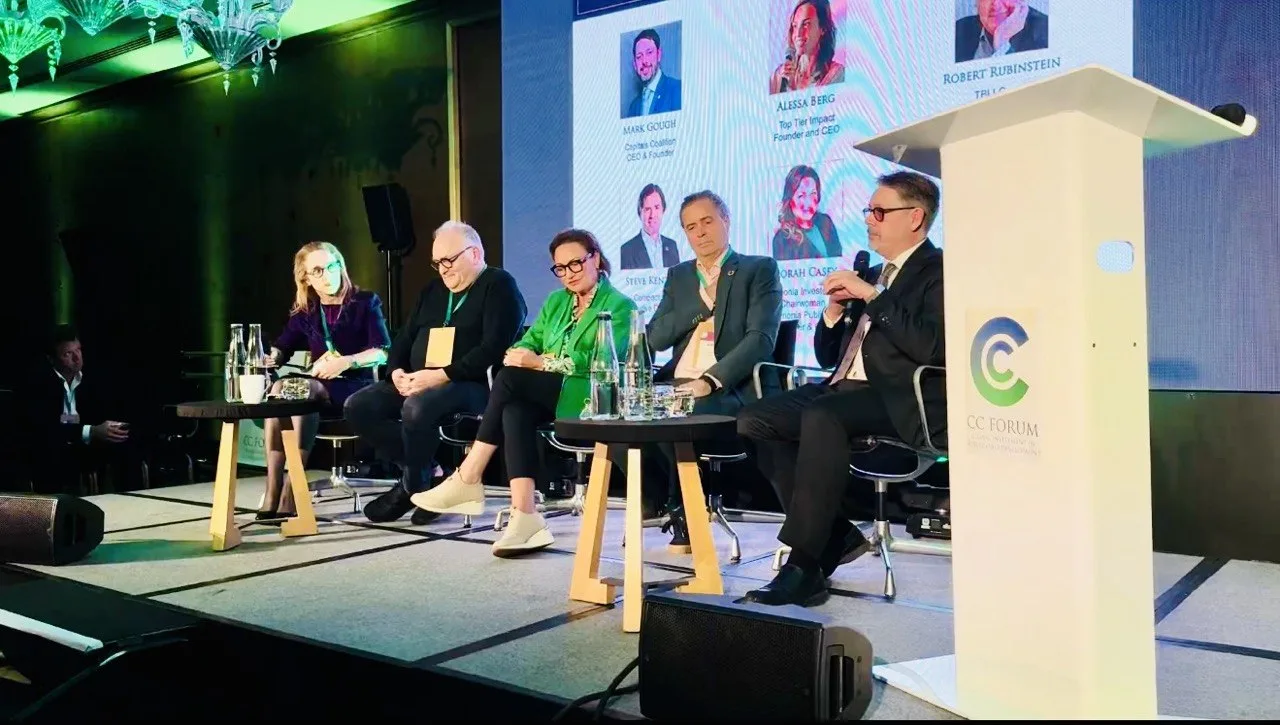
By Maria Bregman
In October 2026 I spent four days at CC Forum London XIV, from a reception at the House of Lords to two days of debate at The May Fair Hotel in Mayfair. Investors, family offices, scientists and philanthropists argued about net zero, ESG and artificial intelligence. Underneath every panel sat a question the programme never printed: can private wealth do what governments have not, for the climate, for nature and for the poorest? I wrote about the forum itself in a full review for Creativity's UK. Here I want to answer that question.
My answer is yes, and it has already started. Nobody at CC Forum was waiting for a treaty. The people in the room were putting up their own money, time and reputations, and the forum itself exists because they choose to.
Lord Zac Goldsmith, the former environment minister, pointed out at the House of Lords that solar has won in Africa on price, without subsidies. He argued that nature can follow the same path once its value is written into the way business is done. Simon Littlewood, who spent two decades financing renewable energy in China, said every project he looked at was overfunded. Lyndsay Howard put the world's investable capital at around $350 trillion. For the investors in the room this was an invitation: they do not have to wait for governments to act.
Terrence Keeley, formerly of BlackRock, proposed his "1.6% solution": if every asset owner put 1.6 per cent of private assets into verified impact, he said, the problem would be solved. Norah Casey challenged ten investors to put one per cent each into a single shared project before COP31. The new CC Forum Foundation asks businesses to pledge 1 per cent of their annual profits. Each of these was sized so that a family office could say yes in an afternoon, and multiplied across the room each adds up to serious money.
Others measured the return in people. Paul Hutchinson left finance to fight child trafficking. Lord Nat Wei said that success in a family office should be counted in "human capacity unlocked". The forum's founder, Max Studennikoff, spent nine months taking the foundation through the Charity Commission, so that causes with no financial return, from Amazonian tribes to great apes in the Congo Basin and ocean plastic, have somewhere to go.
Every problem came with a fix
The speakers were candid about what still needs work, and they brought solutions with their complaints. Robert Rubinstein of TBLI said conservation earns no fees, and proposed tying fund managers' carried interest to measured impact. Keeley showed that the best of three environmental funds he studied traded carbon credits and did nothing for nature. Mark Gough of the Capitals Coalition answered with impact accounting that auditors can check, which he expects within about two years.
Dr Diane Martini described entrepreneurs in poorer countries who cannot pay €30,000 for due diligence before a first loan. Per Wimmer described British scale-ups that have raised their first few million and cannot find the next £15 million. Both gaps are small next to the capital in that room, and they are open to the first family offices willing to fill them. As Rubinstein told the forum's March edition, deals are not scarce for investors who look in the right places.
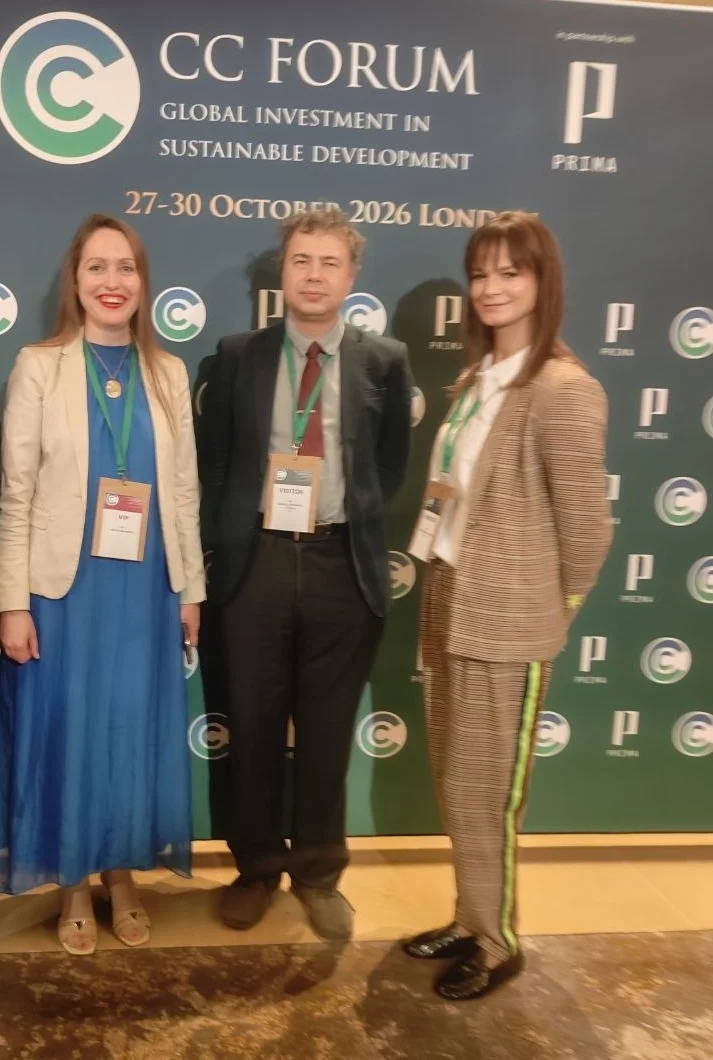
Maria Bregman, George Bregman and Alisa Miroshnichenko at CC Forum London XIV. Photo: Creativity's UK
Finance moves fastest towards what it already knows how to price: solar, small reactors, compressed AI models. Forests, wildlife, adaptation and the poorest regions can follow once they are packaged as projects with a budget, an income and a result anyone can measure. Governments have done this before, and private money can join them.
Israel drained the Hula swamps in the 1950s for farmland and against malaria, and planted forests such as Yatir on the edge of the Negev desert. When the drainage proved too costly for nature, part of the Hula valley was reflooded in the 1990s. The Agamon Hula is now one of the great stopovers on the bird migration route between Europe and Africa, with tens of thousands of cranes each winter and the visitors who come to see them.
Saudi Arabia launched the Saudi Green Initiative in 2021 with a goal of ten billion trees over the coming decades, and says it has planted more than 100 million trees and shrubs so far, mangroves on the coast among them.
Costa Rica began paying landowners to keep and restore forest in 1997, funded by a tax on fuel. Forest cover, which had fallen to about a quarter of the country by the mid-1990s, was back to around half by 2005.
Ecuador in 2023 refinanced $1.6 billion of commercial debt and committed more than $450 million to protecting the waters around the Galápagos.
Indonesia, Goldsmith told the House of Lords, is putting investment into restoring some 12 million hectares of degraded land.
Each of these began with a public decision and grew into something others could invest in. Public money takes the first risk and private money follows. That is the model Kevin Richards brought to the forum for Bermuda, where a reinsurance market and a regulated digital-asset regime could make island projects financeable. It is also the direct financing Hereditary Chief Phil Lane Jr. asked for in March for indigenous communities, who in his argument provide the most cost-effective conservation on Earth. The conservationist Ian Redmond told the forum that the world has lost about three quarters of its wild animals in his working life. That figure is the measure of what is at stake and the best reason to start now.
In the corridors the conversation went further still. Several guests and I kept coming back to an idea no panel touched: a sunshade near the Lagrange point L1, about a million and a half kilometres towards the Sun, large enough to dim sunlight on Earth by around one per cent. In March the forum had heard Marianne Hagen describe a curtain on the seabed to slow the melting of the Thwaites Glacier, a project meant to buy time. The sunshade belongs to the same family on a far larger scale. It will need new rules on who decides to switch it on, and it will need private and public money working together over decades, which is exactly the horizon CC Forum's guests are used to thinking in. I set out what such a shield would ask of us in a separate essay for Creativity's UK, and Venture Signal looks at its cost and governance in The $134bn sunshade nobody owns.
Private wealth will not save the planet alone. But in London this October it was the part of the system that moved first, and the rest can follow.
Sources
- Maria Bregman, "CC Forum London XIV on Capital, AI and Climate", Creativity's UK, November 2026: https://creativitys.uk/cc-forum-london-xiv-2026-review/
- Maria Bregman, "What CC Forum London 2026 Revealed About the Future of Impact Capital", Creativity's UK, March 2026: https://creativitys.uk/what-cc-forum-london-2026-revealed-about-the-future-of-impact-capital/
- Maria Bregman, "A Cloak for the Planet: What a Solar Shield at L1 Would Really Ask of Us", Creativity's UK, November 2026: https://creativitys.uk/aegis-solar-shield-l1/
- Saudi Vision 2030, "Saudi Green Initiative": https://vision2030.gov.sa/en/explore/projects/saudi-green-initiative
- UNFCCC, "Payments for Environmental Services Program, Costa Rica": https://unfccc.int/es/node/256478
- Pew, "To Protect Galápagos Islands, Ecuador Turns to Innovative Financing", May 2023: https://www.pew.org/en/research-and-analysis/fact-sheets/2023/05/to-protect-galapagos-islands-ecuador-turns-to-innovative-financing
- Mongabay, "Ecuador to boost protection of Galápagos in biggest debt-for-nature deal ever", May 2023: https://news.mongabay.com/2023/05/ecuador-to-boost-protection-of-galapagos-in-biggest-debt-for-nature-deal-ever/
- Bar-Ilan University, "Draining Israel's Hula Valley": https://biu.ac.il/en/article/9627
- Venture Signal, "The $134bn sunshade nobody owns": https://venturesignal.org/planetary-sunshade-134bn-governance-investment/
- WWF, Living Planet Report 2024
Maria Bregman is a strategist working across art, technology and capital, and the founder and editor-in-chief of Creativity's UK. She attended CC Forum London XIV as an accredited media partner.