
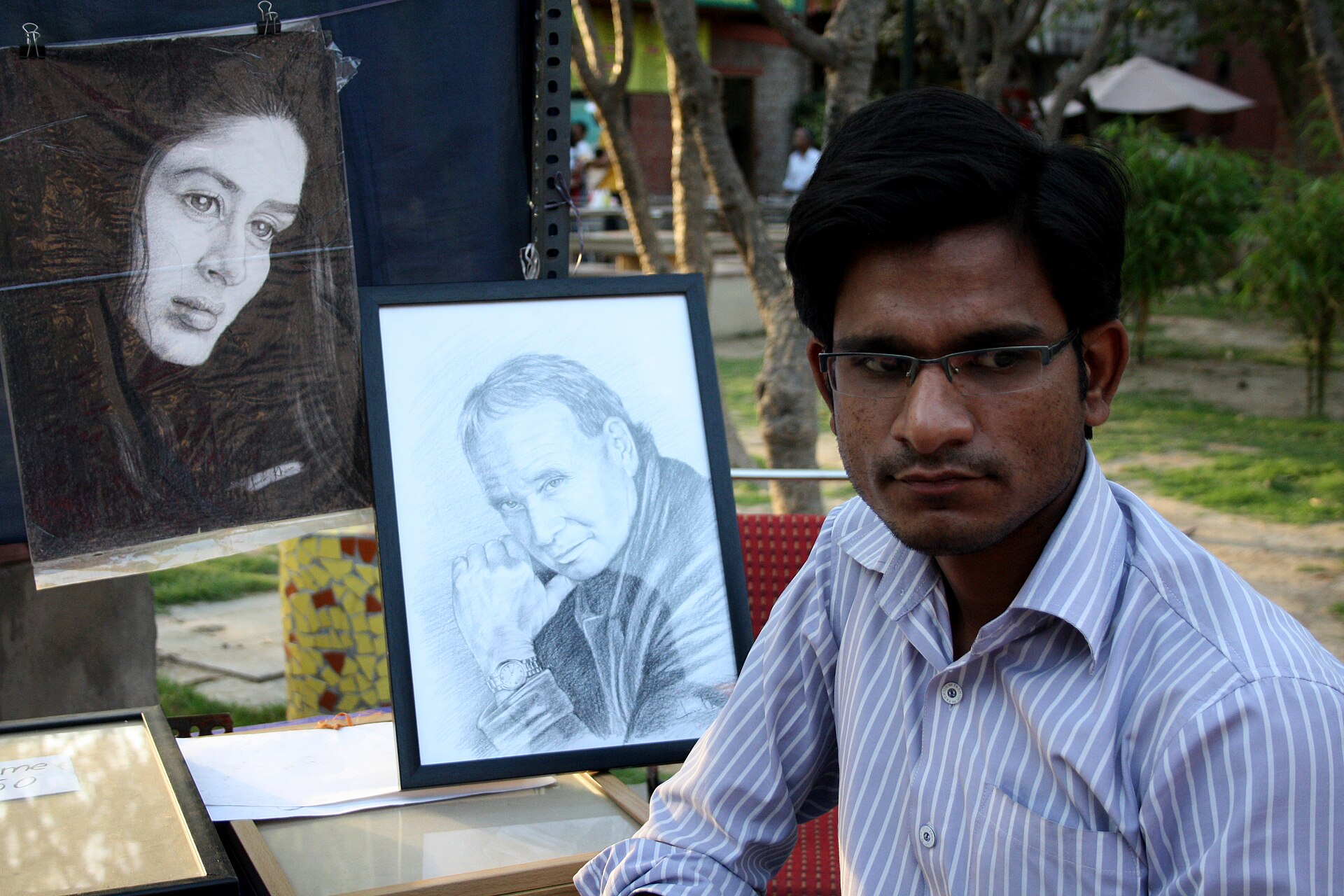
An artist statement is often treated as an exercise in self-justification, written reluctantly under the pressure of a grant deadline or an open-call submission. Many artists respond by adopting an elevated, theoretical vocabulary, in the hope that academic terminology will lend weight to a visual or material practice. Anyone who has sat on a selection committee will recognise the result: paragraphs of dense, abstract prose that obscure the work instead of illuminating it.
Assessment panels, curatorial boards, and residency jurors all work under severe time constraints. An assessor reviewing dozens, or hundreds, of portfolios cannot afford to spend twenty minutes deciphering an elusive philosophical text. What they need is immediate, intelligible context. Inside sixty seconds, an assessor has to understand what you physically or digitally produce, what technical or conceptual inquiry motivates the production, and how your practice exists in the world.
A successful artist statement builds a bridge between your studio thinking and the comprehension of an external reader. It does not replace the artwork, nor does it try to dictate an emotional reaction in the viewer. What it does, instead, is supply the precise scaffolding an assessor needs to evaluate your portfolio with fairness, clarity, and professional confidence.
Clarifying your medium, process, and physical practice
The most frequent error in an artist statement is a failure to tell the reader what the work actually is. Statements often open with vast declarations about memory, identity, time, or spatial politics, which leaves the assessor unsure whether the thing being evaluated is oil paintings, community workshops, sound installations, or responsive digital software.
Begin from a concrete grounding. State your primary media, your typical scale, and the physical or technological reality of your production. Once the physical parameters of the work are understood, assessors can immediately calibrate how they judge your technique, logistical feasibility, and resource requirements.
- Material specificity: rather than describing your work as "mixed-media exploration", identify the specific materials: hand-blown glass, reclaimed industrial timber, single-channel video, or archival inkjet prints.
- Process and technique: explain the manual, chemical, digital, or mechanical processes you employ. Where your methodology relies on traditional joinery, machine-learning models, wet-plate photography, or field audio recording, name those methods plainly.
- Scale and form: clarify whether your work results in intimate pocket-sized artefacts, monumental public sculptures, site-specific architectural interventions, or ephemeral live events.
There is nothing anti-intellectual about describing your physical materials. It is the essential anchor that makes conceptual ambitions credible. Assessors look for harmony between the physical medium chosen and the conceptual questions being investigated, and once that relationship is made explicit, your expertise becomes visible.
Framing your inquiry without academic jargon
Visual and conceptual art engages with complex ideas, yet describing that engagement does not require an impenetrable vocabulary. The phenomenon of pseudo-theoretical writing, which the contemporary art sector usually calls International Art English, relies on inflated suffixes, passive syntax, and fashionable buzzwords that put repetition in the place of depth. Assessors see straight through these linguistic shields.
Instead of asserting that your work "interrogates the liminal interstitiality of relational spaces", state the concrete question that your practice explores. Every mature artistic practice investigates a set of recurring tensions, questions, or curiosities. Frame the work around these genuine inquiries:
- What specific phenomenon, landscape, archive, human interaction, or material tension prompted this body of work?
- What cultural, historical, scientific, or aesthetic lineage does your practice converse with?
- What problem, or unanswered question, keeps driving you back into the studio or the workshop?
Using direct language does not diminish the intellectual rigour of a practice. It proves that your ideas are understood well enough to be explained to another professional. Assessors who understand the fundamental inquiry can readily determine whether a proposed project, exhibition, or residency application aligns with the criteria of their organisation.
Structuring the statement for quick comprehension
An artist statement has to be modular. Different funding bodies, institutional galleries, and residency hosts impose different word limits, anywhere from a 50-word directory summary to a 300-word comprehensive overview. A consistent structural logic keeps the core message intact, whatever the length constraints happen to be.
A standard artist statement of 200 to 250 words works best when it is divided into three clear movements:
The foundational definition
The opening sentences have to deliver immediate orientation. Identify your primary medium, your working context, and the central subject or aesthetic territory you inhabit. An assessor reading this first paragraph should form an accurate mental picture of the physical work, before moving on to the portfolio plates.
The methodology and conceptual engine
The middle section explains how your ideas are transformed into physical or experiential form. Discuss the decisions made during development: how materials are sourced, how data is collected, how subjects are engaged with, or how structural iterations are tested. Keep the focus on the deliberate choices that set your approach apart from other practitioners in the same medium.
The presentation context and audience encounter
The concluding section addresses how the work meets the public. Does it call for a quiet white-cube gallery, an active public thoroughfare, a theatrical black-box auditorium, or a distributed digital platform? Clarify what kind of experience, or dialogue, is intended for the viewer, the participant, or the community.
Distinguishing project proposals from general practice statements
A general artist statement is often confused with a project proposal, and both documents suffer as a result. A general artist statement describes an overarching practice, a recurring methodology, and creative principles across several years. A project proposal, by contrast, sets out a specific undertaking, bound to a period of time, with defined objectives, budgets, and production milestones.
When assessors read a general artist statement, what they evaluate is your creative identity, your consistency, and your professional trajectory. If the whole statement is given over to the details of a single unmade sculpture, or an upcoming performance, the panel cannot discern the wider practice that underpins it.
Keep the general statement focused on durable principles of practice:
- Describe the persistent themes that connect past, present, and emerging projects.
- Bring forward the core working methods that stay constant even as individual subjects shift.
- Use past completed projects as brief illustrations of your general methodology, rather than treating each one as an isolated anecdote.
Where an application form asks for both an artist statement and a project description, treat the two as complementary documents. The statement establishes your credibility and conceptual foundation. The project proposal shows how that foundation will be applied to the specific opportunity at hand.
Calibrating tone, voice, and perspective
Finding the correct register for an artist statement means balancing professional detachment against personal commitment. An artist biography is almost universally written in the third person, whereas an artist statement is traditionally expected in the first person ("I make", "My work investigates").
The first person allows for direct, accountable communication. It does, however, take discipline to avoid slipping into confessional, or purely therapeutic, language. Assessors are rarely interested in how an artist feels during the creative act. What interests them is the intellectual, aesthetic, and cultural significance of the object, or the experience, that has been produced.
Avoid claiming universal significance, or a profound emotional impact, on behalf of your audience. To state that a work "forces the viewer to confront mortality", or that it "radically transforms how audiences perceive ecology", is unprovable, and it presumes an outcome you cannot guarantee. Frame your intentions with professional precision: explain which questions the work presents, which historical materials it juxtaposes, or which spatial conditions it constructs, and then let the assessor, and future audiences, determine the depth of their own response.
Practical checklist for writing an assessor-ready artist statement
- [ ] Identify your primary media, physical materials, and typical scale within the opening two sentences.
- [ ] Articulate the central inquiry or tension that drives the practice, without relying on obscure theoretical jargon.
- [ ] Detail the concrete studio, digital, or field methods used to produce the work.
- [ ] Clarify the intended presentation environment, and the nature of the encounter with the audience.
- [ ] Separate the enduring principles of a wider practice from the specific mechanics of a single project proposal.
- [ ] Write in a clear, active first-person voice, while keeping a disciplined, professional register.
- [ ] Prepare distinct versions of the statement to match the common word counts (50, 150, and 250 words).
- [ ] Read the text aloud, or test it with an informed peer outside your immediate medium, to confirm clarity.
Contributing to BGTC Voice
Artistic practice develops through rigorous reflection, and through the transparent exchange of working methods across creative disciplines. If you have refined a compelling approach to documenting your practice in the studio, to navigating institutional assessments, or to articulating complex craft techniques, we invite you to contribute an essay to BGTC Voice. Submissions should emphasise practical methods and transferable insight that help fellow visual artists and cultural practitioners build careers that last.