
By Maria Bregman, Writer, Founder of the British Global Talent Council and Creativity's UK.
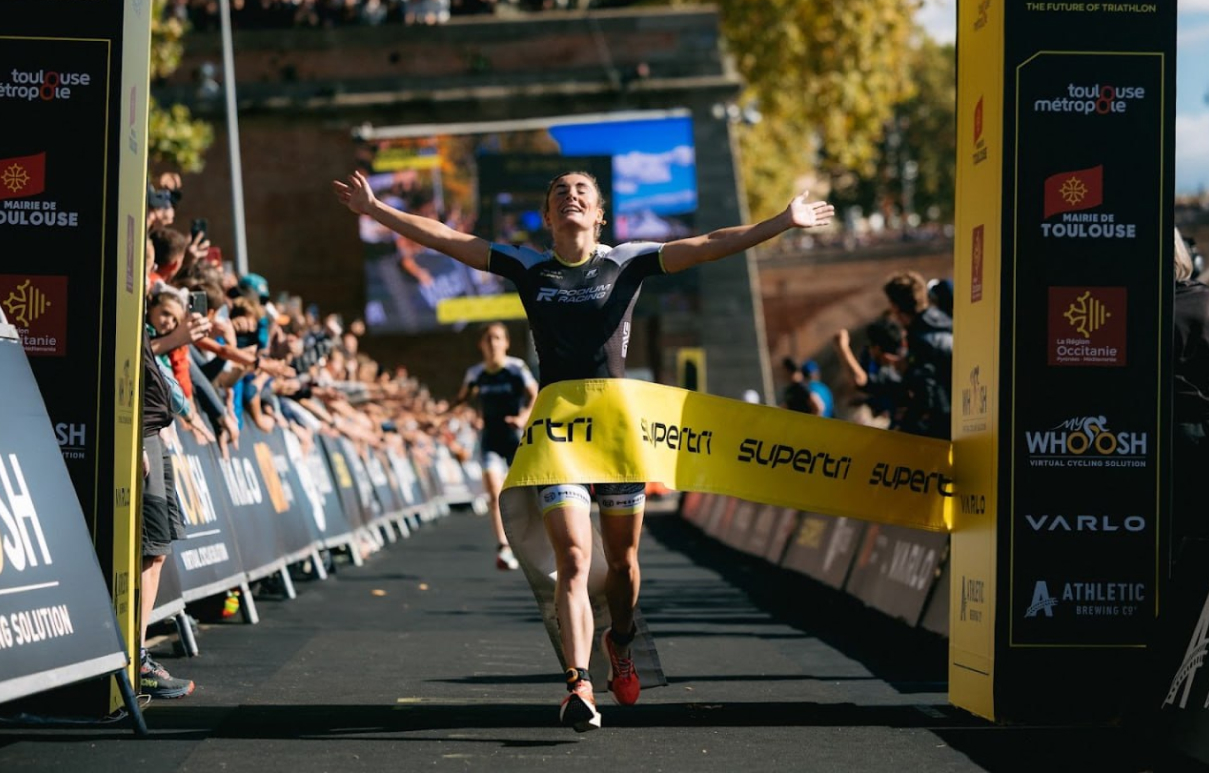
On the afternoon of Sunday 6 September, in a harbour basin in the middle of St Helier, thirty-eight people will swim, cycle and run the same course three times without a pause. Nineteen men and nineteen women, the best short-course triathletes in the world, will race for $800,000, divided equally between them. It is the largest single-day prize fund in the sport this year.
The place is Jersey, an island of 120 square kilometres in the English Channel, closer to Normandy than to England. If you can get there, go. If you cannot, find the time for the broadcast, because this is a rare thing in endurance sport.
The Supertri format sends athletes through three consecutive rounds of swim, bike and run: 300 metres in the water, four kilometres on the bike and 1.6 kilometres on foot, repeated three times with no recovery between them.
Drafting is allowed on the bike, keeping riders close together. A solo escape burns energy that the chasing group can save, so the bike leg is decided as much by position as by strength. You do not need a coach’s eye to see a decision being made; you watch the athlete make it, and you watch what it costs.
For a century, endurance was a human drama that television could not quite hold.
When I spoke to Michael D’hulst in June, I asked him how Supertri came about and what part Jersey plays in it.
“I’m originally from Belgium,” he said. “In 1996 there was a Belgian who won the world championship in Hawaii, and I was motivated and said, oh, I want to try this.”
The Belgian was Luc Van Lierde, who that October became the first European to win at Kona. D’hulst was watching, and thirty years later he runs Supertri, the company that carries that dream forward.
“It’s the moment of wow, this looks exciting, I want to do this,” he said. “And that is what it delivers.”
He is clear about what Jersey represents. “This is the pinnacle moment,” he said of 6 September. “It’s the best of the best racing for big prize money, so it gets a lot of attention, and it gives the aspiration for other people.”
On 6 September, Olympic champions and world champions will come together for the Supertri final, the super final of the 2026 season.
The most interesting thing he said reached well beyond sport.
“You’re giving people an experience, you’re giving them a sense of belonging, you’re giving them the confidence, the sense of achievement,” he said. “People want that, people need that.”
What Supertri actually is
Triathlon is not a new sport and it is not an exotic one. It is made of three things that almost every child already does: swimming, cycling and running. What Supertri adds is a start line, a finish line and thousands of other people doing the same thing.
This is why you can enter the sport at any point in life. At Blenheim I watched people in their seventies come through the same finish arch as Olympic medallists, a few hours later, on the same course. Almost no other sport offers that geometry.
D’hulst believes the real obstacle is not fitness but resolve.
“The fitter you are, the faster you will go,” he said. “But the mind game never changes.”
And more directly: “Everybody can do it, in my opinion. With a little bit of training, everybody can do it. You just have to believe.”
He thinks this is why the sport has such a grip on people who run companies. “Triathlon is almost a metaphor for life,” he said. “Sometimes it goes good, then it doesn’t go good. Then you struggle. You have to come back.”
About children I would put it this way. A child who trains for something, finishes it and is met at the line by people who know their name learns that difficulty is survivable, that a goal can be reached and that they belong to a group. The medal and the win are not the main thing here. The community around them matters far more.
How the series came to Jersey
Jersey is a British Crown Dependency and not part of the United Kingdom. It has its own laws, taxes and parliament, with English as its working language and Jèrriais surviving in place names and occasionally in speech.
D’hulst calls the island the spiritual home of the series, and there is a specific history behind the phrase.
Super League Triathlon was founded in 2017 by D’hulst, McCormack and Boguslavsky. The first event was staged that March on Hamilton Island, off the coast of Queensland, and featured a men’s professional race only. Jersey hosted the second, in September 2017, and that was the first to include a women’s race. Katie Zaferes won it, ahead of Summer Cook and Nicola Spirig.
The island has since staged the race in 2018, 2019, 2021 and 2025. September will be the sixth.
How the series came to Jersey
Jersey is a British Crown Dependency and not part of the United Kingdom. It has its own laws, taxes and parliament, with English as its working language and Jèrriais surviving in place names and occasionally in speech.
D’hulst calls the island the spiritual home of the series, and there is a specific history behind the phrase.
Super League Triathlon was founded in 2017 by D’hulst, McCormack and Boguslavsky. The first event was staged that March on Hamilton Island, off the coast of Queensland, and featured a men’s professional race only. Jersey hosted the second, in September 2017, and that was the first to include a women’s race. Katie Zaferes won it, ahead of Summer Cook and Nicola Spirig.
The island has since staged the race in 2018, 2019, 2021 and 2025. September will be the sixth.
The stakes and the field on Jersey
The prize fund is $800,000 for a single day of short-course racing: $400,000 for the men and $400,000 for the women. Each winner receives $100,000, with payments running down to tenth place.
Jersey is also the one weekend of the year on which the professionals of the series race on their own. Adam Leitch, Supertri’s communications director, calls it “our only ‘standalone’ elite event of the year.”
Jersey is the concentrate: thirty-eight athletes, nineteen of each, and “the very best of the best, including both Olympic gold medallists from Paris,” racing the original Supertri format with $800,000 on the line.
In the men’s race, Alex Yee, the Paris 2024 Olympic champion, meets Hayden Wilde of New Zealand. Yee beat Wilde by six seconds after overturning fourteen in the closing kilometre of those Games, and again by a single second at the Grand Final in NEOM that November.
They are joined by reigning Supertri champion Csongor Lehmann, current world champion Matt Hauser, Olympic mixed-relay champion Tim Hellwig and three-time Olympic medallist Jonny Brownlee.
The women’s race is no gentler. Jeanne Lehair, reigning Supertri champion and last year’s Jersey winner, defends her title against Olympic champion Cassandre Beaugrand, Georgia Taylor-Brown and Jolien Vermeylen, who won the Blenheim qualifier.
The three qualifying events of the rebuilt 2026 season, in Austin, Blenheim Palace and Toronto, each sent their top three of either sex to this start line. The athletes race as individuals this year rather than for franchise teams.
The morning before
Beginners will not start alongside the professionals on Jersey. Instead, the same day gives amateurs races and programmes of their own.
Before the professionals take the course, the island runs the RBC Race for the Kids Jersey in partnership with Supertri, with routes of 2.5, 5 and 10 kilometres that can be walked, run or wheeled. The previous edition raised £56,000 for the Jersey Child Care Trust.
Around the children’s race sits a schools programme. Every Jersey school that signs up receives Supertri Active School status. The school with the highest participation becomes the island’s Supertri Champion School and receives access to the elite athletes and a look behind the scenes at the final.
“We do a lot of community activation across the event,” Leitch told me.
Then there are the corporate teams. D’hulst described the alternative to traditional client entertainment as “a very different experience” where people do a triathlon together. Teams from UBS, the Royal Bank of Canada and a large insurer have raced in that format, coached by Olympians.
I asked D’hulst, as a filmmaker, what he thought triathlon was missing. He answered with a story.
“The best things that were done, and I go back to the late nineties, early two-thousands, NBC always had a documentary about Ironman Hawaii,” he said. “The documentary was always twofold. It followed the professional race, but it also followed some inspirational stories of normal people.”
Then he gave one of his own. Two years ago in Chicago a boy of seventeen or eighteen signed up for his first triathlon. Shortly afterwards he was diagnosed with blood cancer. He went through treatment, and a year later wanted to come back and race. They coached him. He finished.
“That is the most powerful thing in triathlon,” D’hulst said. “Finding stories of people who do something incredible, who have overcome adversity and started doing triathlon, and it changed their life.”
Every sport becomes part of the general culture when it produces a single image that everyone remembers. Endurance had no such image for a long time: the race lasts for hours, and the decisive moment is almost invisible from the outside.
The founding exception occurred in February 1982 at the Ironman World Championship in Hawaii. Julie Moss was leading the women’s race when, in the last few hundred metres, her body stopped accepting instructions. She fell, stood, fell again and crawled across the line in second place, and an ABC crew filmed all of it.
Supertri, deliberately or otherwise, has given this material a shape that fits on a screen.
Supertri currently works with sixteen global broadcasters. The races also go out on Supertri’s own digital channels, where every race will be shown live.
How to watch on 6 September
Watching in person is free. Sixteen global broadcasters carry the series, and the races also go out on Supertri’s own digital channels.
If you go, come for the whole day. The morning belongs to the community races. The afternoon belongs to the professionals.
On the afternoon of 6 September, on the island of Jersey, the best athletes in the world will cover the course three times at full speed. The season will come down to this final race, the super final of Supertri 2026.
I’ll be there on the island. Do join me to see who wins Supertri Jersey 2026.