
By Maria Bregman – founder and Editor-in-Chief of Creativitys.UK; writer, filmmaker, and UK Global Talent.
For one day each year, Supertri brings swimmers into the Garonne, transforming the historic centre of Toulouse into a racecourse open to everyone, from first-time participants to experienced triathletes.
A triathlon through the city
Toulouse offered a different perspective on Supertri's approach to endurance sport. Unlike the countryside setting of Blenheim Palace or the waterfront course on Jersey, the French city's 2026 event took place in the middle of everyday urban life. Athletes swam in the Garonne, cycled on roads closed to traffic and ran through streets usually occupied by residents, students and visitors.
Founded in 2017 as Super League Triathlon by Michael D’hulst, Leonid Boguslavsky and four-time world champion Chris McCormack, Supertri set out to make triathlon more accessible to spectators through shorter, faster races. The series has since expanded its focus to include mass-participation events, bringing professional competition and amateur sport into the same calendar.
The scale varies across its venues. Blenheim Palace hosted approximately 6,000 participants over a weekend in June 2026, while Jersey staged the Pro Series Final in September, with Olympic champions competing for an $800,000 prize fund. Toulouse closed the season with a different proposition: an event dedicated to amateur athletes, set against the backdrop of a major European city.
The course began at the Prairie des Filtres, a riverside meadow beneath the Pont-Neuf. From there, participants entered the Garonne before continuing by bike and on foot through the city centre. Spectators could follow the race from bridges, embankments and streets along the route.
“Most of the time triathlons are just outside the city,” said Fabrice Preau, Supertri's French press consultant. Toulouse offered the opportunity to bring the competition directly into the urban environment.
The Garonne: an unusual starting point
The river was one of the event's defining features. Although the Garonne is central to Toulouse's landscape and social life, swimming in it is generally not permitted. Supertri's authorisation therefore gave participants an opportunity to enter a stretch of water usually experienced from the riverbanks.
More than 1,500 people were expected to take part in the event on 4 October. Three distances were available, each open to individual competitors and relay teams:
-
XS: 400 metres swimming, 10 kilometres cycling and 2.5 kilometres running.
-
S: 750 metres swimming, 20 kilometres cycling and 5 kilometres running.
-
M: 1.5 kilometres swimming, 40 kilometres cycling and 10 kilometres running.
The range allowed newcomers to try the sport without committing to an Olympic-distance race, while more experienced athletes could choose a longer challenge.
The Prairie des Filtres also has a historical connection to the river. During the nineteenth century, its sandy soil helped filter water drawn from the Garonne before it was pumped into the city's supply system. The former water tower remains a landmark nearby. The site from which competitors entered the river had once played a role in bringing that same water to Toulouse's residents.
For local participants, the swim was consequently more than the first stage of a race. It offered access to a familiar part of the city in an unfamiliar way.
A young city with a strong sporting identity
Toulouse is France's fourth-largest city and a major university and aerospace centre. Its urban area includes more than 120,000 students, according to figures cited in the original report, while Airbus has a substantial industrial presence in nearby Blagnac.
The city's historic centre is known as la Ville Rose, or the Pink City, after the warm colours of its traditional brick buildings. The Capitole, the Garonne's bridges and the surrounding streets provide a distinctive setting for an event that relies on close contact between athletes and spectators.
Yet triathlon has had to establish its place in a region better known for rugby. Preau credited local clubs, particularly Triathlon Toulouse Métropole (TTM), with helping develop the sport and support Supertri's presence in the city.
The local club provides volunteers who help manage the course, direct participants and support the event. According to registration figures shared by the organisers before race day, approximately 44 per cent of participants had travelled from outside Toulouse.
That proportion suggests the event attracts more than a local audience. It also demonstrates how a city-centre race can draw visitors while remaining accessible to residents.
For Victoria Tuneva, a Toulouse-based reporter for Creativity’s UK and a master's student in Global Management at Toulouse School of Management, the event reflected the city's close-knit student culture. She described the Garonne, the Capitole and Place Saint-Pierre as central parts of everyday life, with the latter particularly popular among students.
On race day, she noticed how the competition brought residents together.
“Everybody is cheering, people are trying their best on the race, and it's just amazing energy,” she said, describing the support participants received along the course.
From spectators to participants
Toulouse had already hosted Supertri's professional series, including the 2025 final, when Jeanne Lehair won by three seconds. That edition also featured a mass-participation race, which organisers said attracted around 1,300 entrants.
In 2026, the focus shifted entirely to amateur competition.
The format brought together first-time triathletes, experienced participants and local athletes who wanted to race without travelling far from home. The closed cycling course and volunteers positioned along the route also contributed to participants' sense of security.
For many spectators, the event offered a practical introduction to the sport. Pierre, a local resident watching from the barriers, said the race gave Toulouse positive visibility and inspired him to consider taking part himself. Other spectators came to support friends and relatives, turning sections of the course into informal gathering places.
The connection between watching and participating is central to Supertri's strategy. At Blenheim, chief executive Michael D’hulst described the moment the series wants to create: a spectator sees the race and thinks, “This looks exciting, I want to do this.”
In Toulouse, that transition was visible among the local crowd. Friends came to cheer for participants, families gathered near the finish and amateur competitors raced through streets they knew well.
Sport and community impact
The Toulouse event also supported a local cause through its partnership with IUCT-Oncopole, a cancer treatment and research centre in the city.
The initiative formed part of Octobre Rose, France's annual breast cancer awareness campaign. TTM volunteers wore pink, while a special XS race and a limited-edition Supertri T-shirt helped raise funds for the centre. Organisers said the proceeds from the special race and merchandise would go to Oncopole.
The partnership began in 2024. Preau recalled that, during the Paris Olympic Games, the organisers had brought members of the French Olympic team to the centre so that patients undergoing treatment could meet athletes despite being unable to attend the competitions themselves.
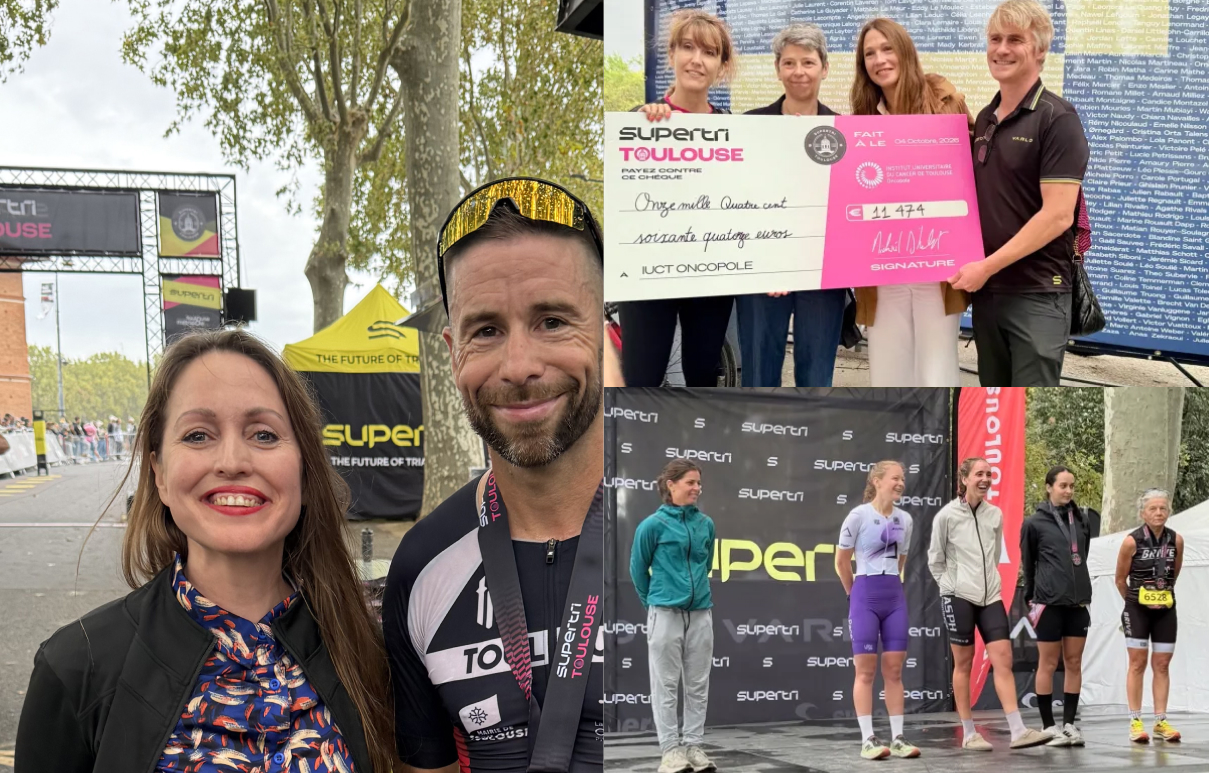
At the Toulouse event, two Oncopole researchers received a cheque on stage. One, a professor of immunology and medical oncologist, explained that his team studies treatment resistance in triple-negative breast cancer, an aggressive form of the disease that can affect younger women.
Funding supports research into why some patients respond to treatment while others do not. The previous year's contribution had supported a project using artificial intelligence to analyse breast tumour samples.
The initiative gave the race a purpose beyond participation and tourism, connecting a public sporting event with ongoing medical research.
The mental side of endurance
Across the Supertri events she attended in 2026, Maria Bregman repeatedly asked participants whether the body or the mind gives way first during a race.
The answers were remarkably consistent. Ray, a triathlete approaching her seventieth birthday and taking part in her fourteenth race, said training gave her confidence in her physical ability even when her mind questioned whether she could continue. Olympic medallist Jonny Brownlee similarly argued that mental commitment can help athletes push through physical difficulty.
Tuneva gave the same answer in Toulouse: the body can be trained, she said, but without the right mental attitude, completing the challenge becomes harder.
The event's inclusive structure gave that idea a practical dimension. Participants did not need to be professionals or elite performers. They needed to choose a distance, prepare for three disciplines and arrive at the start.
Preau recommended the XS distance for beginners, describing it as a way to experience the transitions between swimming, cycling and running before progressing to longer races.
The next stage for Supertri
Toulouse's future with Supertri appears promising. Deputy mayor Julie Servat, whose responsibilities include professional sport and sports policy, said the city intended to continue working with the series and expected further discussions about upcoming editions.
The event also fits into Supertri's broader development plans. Following the 2026 season, the organisation intends to strengthen its relationships with clubs and teams and develop the Enduro format, which grew out of Jonny Brownlee's challenge of completing ten sprint triathlons over a weekend at Blenheim.
The series has also expanded its UK calendar through Supertri Brighton, scheduled for 29 August 2027, alongside its established Blenheim event. Its wider participation target is 30,000 athletes across its events, including 10,000 first-time participants.
Toulouse demonstrates how this strategy can work in an urban setting. A city-centre course makes the race visible, local clubs help deliver it, and a range of distances gives newcomers a route into the sport.
The event's defining moment came from Ginny, a Toulouse native who had previously watched Supertri's professionals from the sidelines. In 2026, she entered the race herself and swam in the Garonne before cycling and running through her home city.
Afterwards, she described the experience by recalling Jeanne Lehair's victory at the 2025 final.
“I felt as if I were Jeanne Lehair last year.”
The comparison captured the connection Supertri seeks to establish between elite competition and amateur participation. The professionals provide a point of reference, but the experience of racing is no longer reserved for them.
For Toulouse, the event brought international sport into the historic centre while giving residents an opportunity to take part. For Supertri, it offered another example of how endurance sport can become both a spectator event and an accessible community activity.
The Garonne will not become an everyday swimming venue overnight. But for one day, the river, the streets and the city itself became part of the race.
By Maria Bregman, https://en.wikipedia.org/wiki/Maria_Bregman. Maria Bregman bridges art, technology, and global business https://mariabregman.com.