
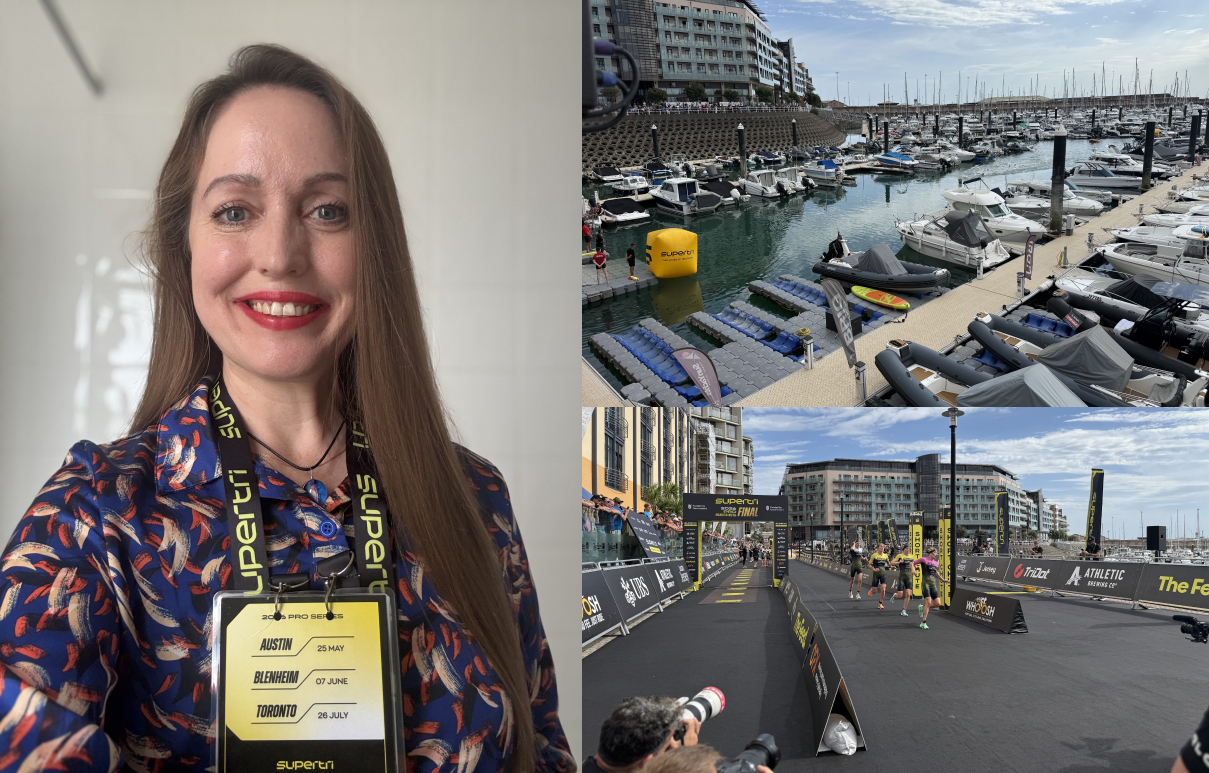
By Maria Bregman, founder of the British Global Talent Council; film critic, documentary director and UK Global Talent.
On Sunday 6 September 2026, the St Helier waterfront became the setting for the Supertri Pro Series Final. Olympic champions Cassandre Beaugrand and Alex Yee, world champion Matt Hauser and other leading short-course triathletes competed for an $800,000 prize fund, the largest single-day purse in triathlon this season.
For Supertri co-founder and chairman Leonid Boguslavsky, bringing such a field together reflects the platform the organisation has spent years building. Chief executive Michael D’hulst sees the same principle in the start list itself: established champions, emerging athletes and a format capable of producing decisive moments within minutes.
The Jersey final offered a useful way to understand that model from the inside. Across three days, the professional races sat alongside children's events, corporate competition, community activities and charity fundraising. On an island of roughly 103,000 people, the event became both an international sporting broadcast and a local festival.
Designing triathlon for television
Triathlon has traditionally been difficult to package for television. The full Ironman distance can take elite athletes around eight hours and recreational competitors considerably longer. Much of the race takes place over long stretches of road, while decisive moments can be difficult to follow from a fixed camera position.
Supertri was created partly as a response to that problem.
Boguslavsky, who began competing in long-distance triathlon later in life and qualified four times for the Ironman World Championship, co-founded Super League Triathlon in 2017 with D’hulst and four-time world champion Chris McCormack. The organisation later became Supertri, with a format designed around a complete race narrative lasting roughly 55 minutes.
Each athlete completes three consecutive rounds of a 300-metre swim, 4-kilometre bike and 1.6-kilometre run. Athletes who fall too far behind can be eliminated, while the Short Chute can allow a competitor to reduce the course near the end.
The rules create a race with little room for recovery. Drafting keeps athletes close together, making positioning important, while transitions become part of the competition itself. Equipment must be handled precisely, and a helmet or other item outside its designated box can result in a five-second penalty.
On a course this short, seconds can determine the podium.
A format built around decisive moments
The Jersey final demonstrated the consequences of that structure.
Alex Yee entered the men's race after a year away from racing Hayden Wilde on the same start line, but a broken chain during the second bike stage ended his challenge. Canadian Tyler Mislawchuk was eliminated even earlier after a course cone struck his front wheel.
Matt Hauser avoided those problems and remained with the leaders before making the decisive move on the final run. The Australian finished in 52:06, seven seconds ahead of Wilde, with Dutch athlete Mitch Kolkman taking third.
Cassandre Beaugrand dominated the women's race, winning in 56:45 and finishing 19 seconds ahead of Georgia Taylor-Brown. Behind them, however, the compressed format produced its own disruptions. Jess Fullagar and Taylor-Brown collided during an attempted breakaway, while defending champion Jeanne Lehair lost time when her helmet became caught in her hair during transition.
Lehair eventually recovered to take bronze.
The race also included two under-23 athletes, Lottie James and Eve Whitaker, experiencing their first Supertri final alongside Olympic champions. Jersey wildcard Siena Stephens, racing professionally on her home island for the second consecutive year, received some of the loudest support from the local crowd.
For Supertri, these incidents are more than sporting accidents. They illustrate the central proposition of the format: the race is compact enough for almost every mistake, tactical decision and change of position to become visible to spectators.
Why Jersey works
Jersey provides an unusual environment for that concept.
The British Crown Dependency sits close to Normandy and has a population of around 103,000. Its harbour is framed by historic granite architecture, while Elizabeth Castle stands on a tidal islet opposite St Helier. The island also has a long sporting tradition and has participated in every Commonwealth Games since 1958.
Supertri has an established relationship with Jersey. The island hosted the league's second event in 2017, including its first women's race, and returned to the calendar in 2018, 2019, 2021 and 2025. The 2026 final was the sixth event held there.
The course makes the location part of the product. Athletes swim in the harbour, cycle along the waterfront and race through tight turns and narrow sections shaped by the existing geography. Spectators can stand close to the course and see the athletes repeatedly rather than watching them disappear into a distant road circuit.
That matters for an event designed around television as much as for the people watching from the barriers.
Jersey is also pursuing UNESCO Global Geopark status, linking its geological heritage with sustainable community development. Supertri's use of the coastline and harbour provides a natural way to showcase that landscape while creating an event with a clear connection to the local economy and tourism strategy.
A sporting event beyond the professionals
The Pro Series Final is only one part of Supertri's Jersey model.
The weekend included a UBS Corporate Challenge, a local Swim Run, a parkrun and the RBC Race for the Kids, which attracted more than 700 participants across 2.5, 5 and 10-kilometre routes in support of the Jersey Child Care Trust.
The professional athletes were also involved outside the main race. Alex Yee, Georgia Taylor-Brown, Hayden Wilde and Siena Stephens visited Acorn, a local charity, with sports equipment collected through a partnership between UBS and Supertri.
The corporate race involved 120 participants from Jersey businesses. For D'hulst, this is an important part of the concept: companies can bring clients and employees into the same sporting environment rather than simply hosting them in a conventional hospitality setting.
The same approach extends to schools. Victoria College Preparatory School won the Supertri Champion School trophy for the second consecutive year, while pupils were able to meet professional athletes before the final.
The result is a weekend in which elite sport, amateur participation and community programming occupy the same waterfront.
The business behind the spectacle
Supertri's relationship with Jersey is also built around a wider institutional partnership involving the Government of Jersey, Visit Jersey, Locate Jersey, RBC and UBS.
The Government contributed £100,000 to the 2025 event. Previously published figures reported $356,000 in spending with local suppliers in 2021. For Jersey, the value lies not only in direct event activity but also in international exposure: the race is distributed through 16 global broadcasters while presenting the island as a destination for sport and outdoor activity.
That fits the government's broader Inspiring an Active Jersey 2020–2030 strategy, which aims to increase physical activity among residents while positioning Jersey as an active destination.
The partnership therefore serves several objectives simultaneously: professional sport, tourism, community participation, corporate engagement and charitable fundraising.
The $800,000 prize fund also reflects Supertri's attempt to build a commercially sustainable professional circuit. The money was divided equally between the men's and women's races, with $100,000 going to each winner and prize money extending to tenth place.
From elite racing to mass participation
Jersey sits at the top of a broader Supertri ecosystem.
At Blenheim Palace in June, the organisation staged one of the UK's largest triathlon weekends, with around 6,000 participants. The event combines mass participation with a historic location and allows amateur athletes to race on the same course as elite competitors.
North America represents another major growth area. Chicago attracted more than 9,000 athletes in 2025, while D'hulst reports year-on-year registration growth of 33 per cent in Chicago, 25 per cent in Toronto and 21 per cent in Long Beach.
Supertri has also acquired the Brighton & Hove Triathlon, which will become Supertri Brighton in 2027.
The structure is therefore becoming increasingly clear: mass-participation events introduce people to the sport, major city races expand the audience, and the Pro Series provides the premium professional product.
The organisation's stated target is 30,000 participants across its events, with one third new to triathlon.
Building an audience beyond traditional broadcasting
Supertri's media strategy is equally important.
The organisation continues to distribute its races through global broadcasters, but it is also developing its own digital audience at a time when traditional sports-rights economics increasingly favour only the largest properties.
Short-form content is central to that approach. Three clips pinned to Supertri's TikTok account have collectively generated more than 70 million views, while content from the Jersey final passed two million views on Instagram in the days following the event.
This is particularly suited to the format. A transition mistake, penalty or sudden change in position can become a standalone piece of content without requiring an audience to understand an entire eight-hour race.
The next stage will be the Enduro format, which developed from Jonny Brownlee's final major challenge as a professional athlete: completing ten sprint triathlons in one weekend. It is intended to create another connection between elite racing and age-group participation.
The 2026 season concludes in Toulouse on 4 October, with a swim in the Garonne, a closed-road cycling course and a run through the historic centre.
A different model for endurance sport
Jersey illustrates what Supertri is trying to build around triathlon: a professional competition designed for television, a participation platform for amateurs and a festival that can become part of the host community.
The professional final lasts less than an hour, but the wider event occupies the waterfront for three days. Olympic champions share the programme with children, corporate teams, local clubs and charity runners.
That combination is central to Supertri's proposition. Rather than treating elite competition and mass participation as separate products, the organisation is building a calendar in which they reinforce one another.
Jersey provided a particularly concentrated example: a small island, a compact course, an international field and a local audience close enough to hear the athletes breathe.
For a sport historically associated with endurance measured in hours, Supertri is testing a different measure of attention: how much can happen, and how much can be seen, in less than an hour.